Hollow-Core 3D Printing
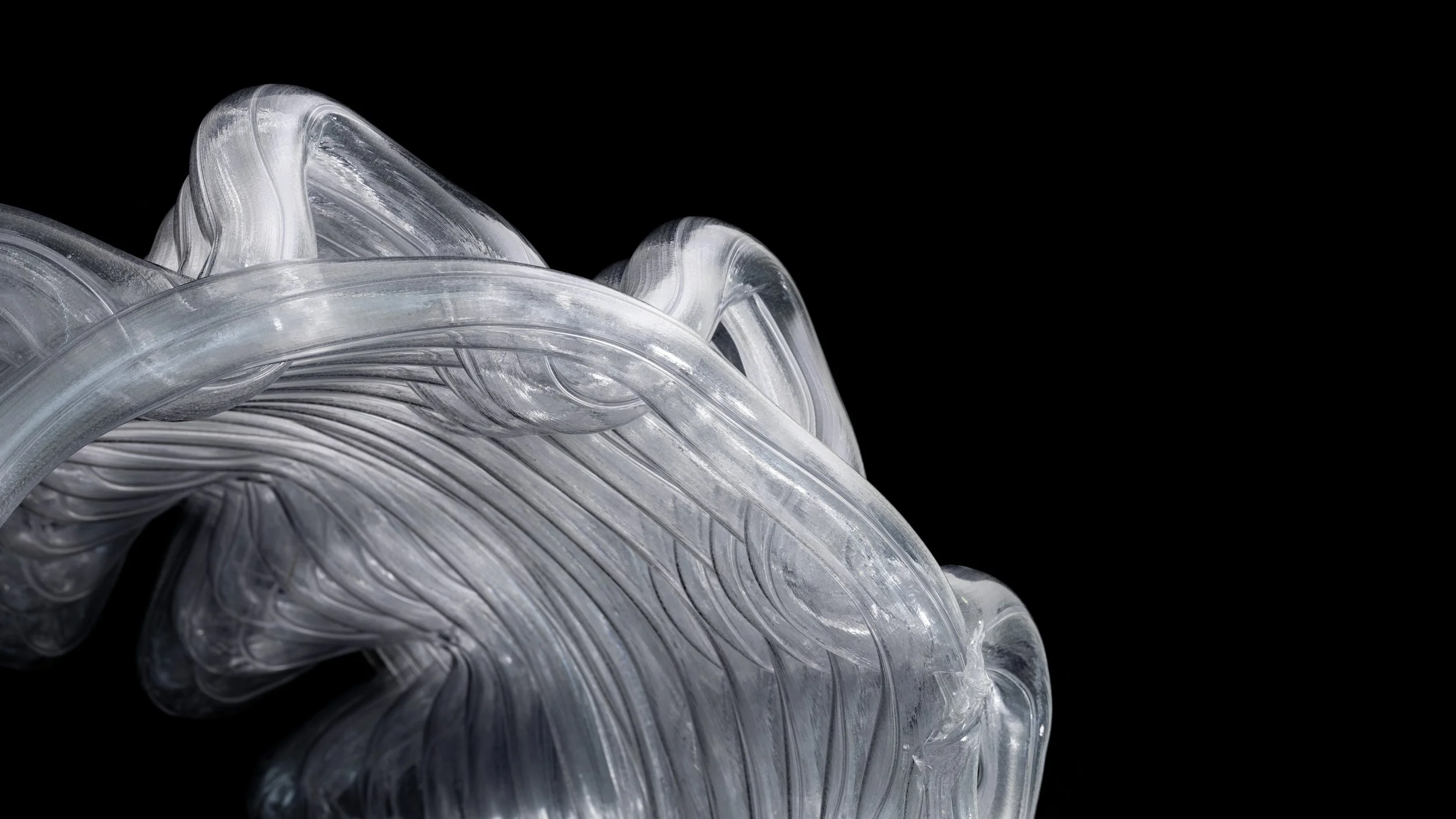
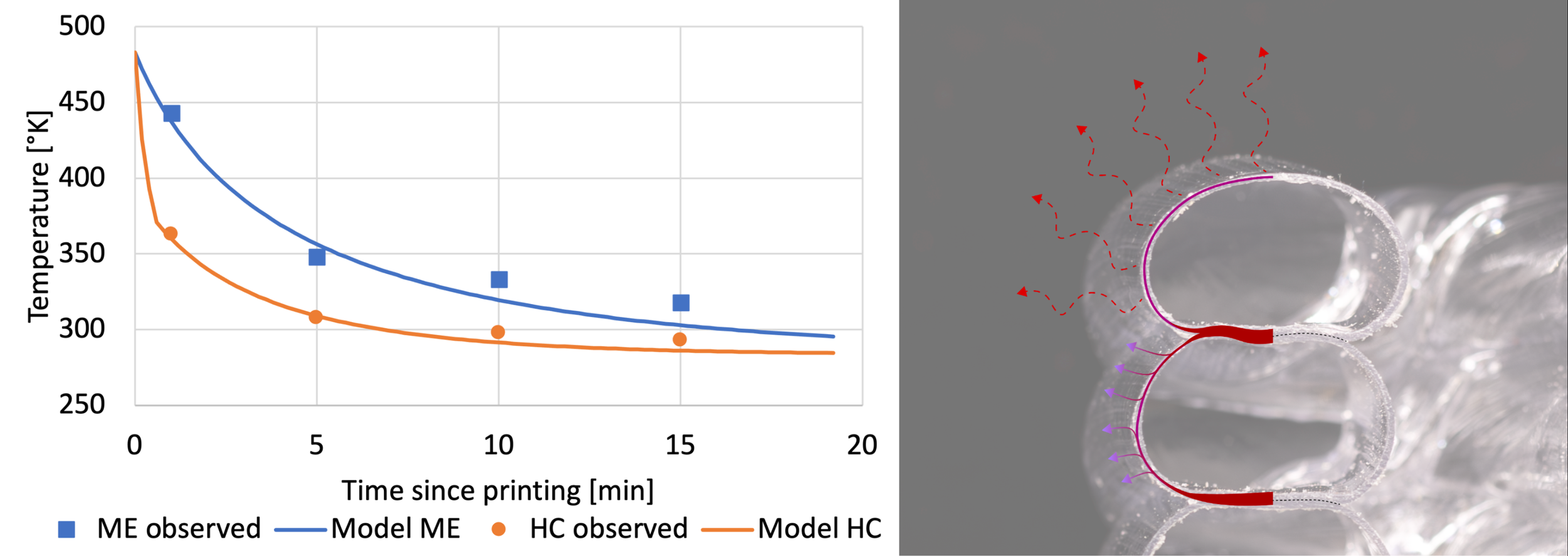
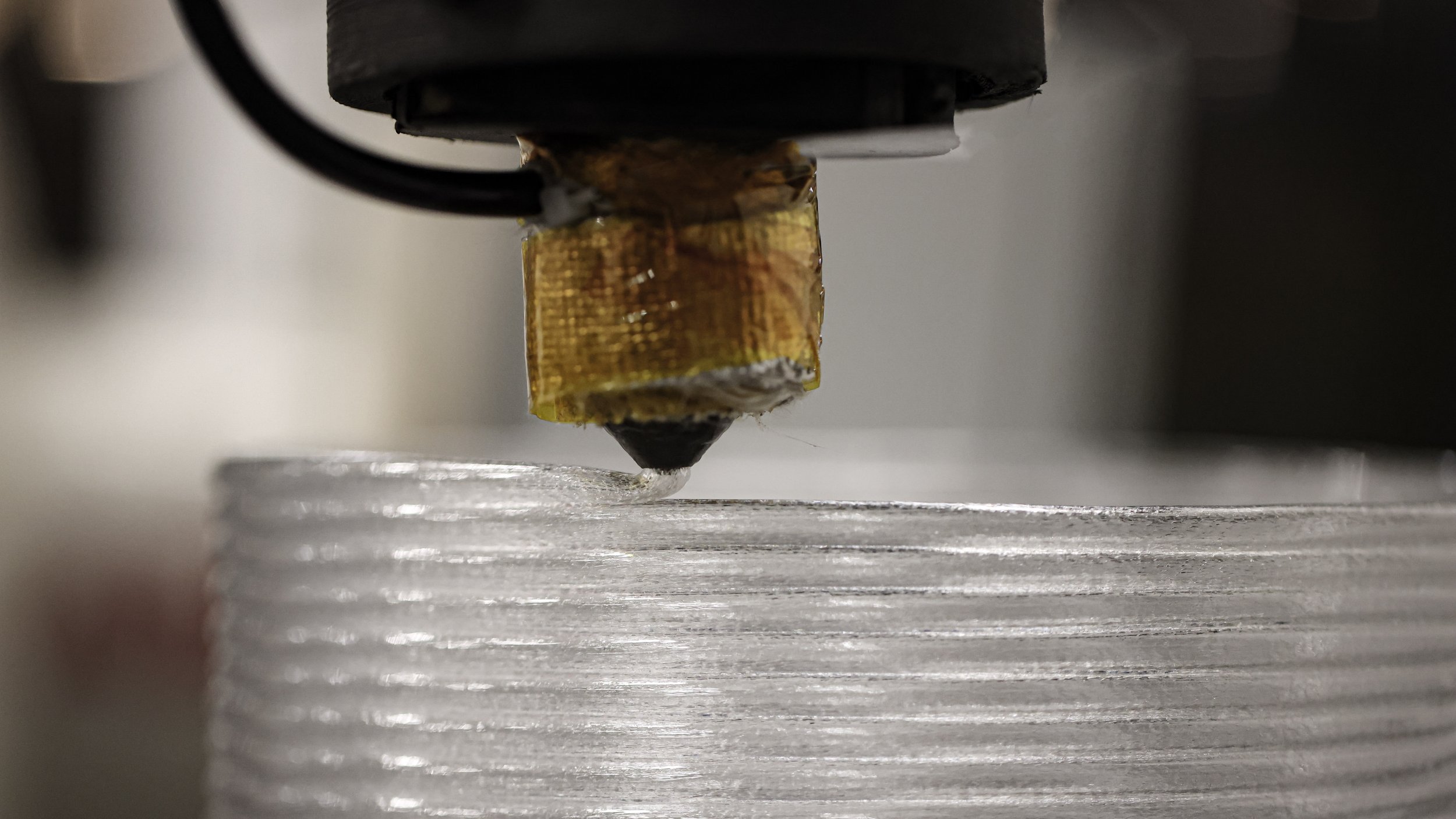
Large-scale material extrusion (ME) is limited not by how much polymer an extruder can melt but by how long a deposited bead takes to cool before the next layer can be placed on it. Larger beads carry more material and cool more slowly, since volume grows faster than surface. Scale is therefore paid for twice, in material and in time. Hollow-Core 3D Printing (HC3DP) separates the two: a closed tubular bead, formed at the nozzle and held open by regulated internal air pressure, cools from both sides at the rate its wall thickness dictates, so the deposited cross-section can grow while the cooling time does not.
PERIOD
2020-today
CONTEXT
Doctoral research, Chair of Digital Building Technologies, ETH Zurich — NCCR Digital Fabrication (Swiss National Science Foundation, 51NF40-141853) - embedded in Project 1C, Integrated 3D Printed Facade.
PATENT
Arrangement for Additive Manufacturing of a Structure. EP22201353.4, 2022. Dillenburger, B., Leschok, M.
FUNDING
Swiss National Science Foundation, Digital Process Chain for Hollow Core Extrusion (10003387), CHF 916k, 2024 — part of the application consortium, contributor.
IBAM InnoBooster, Enhancing thermal insulation of building components through custom nozzle design for tubular 3D printing, CHF 20k, 2024 — co-author.
PUBLICATIONS
Leschok, Matthias. “From Water-Soluble towards Hollow-Core 3D Printed Formwork.” In Digital Formworks for Sustainable Construction, edited by Ena Lloret-Fritschi, Giorgio Castellano, Andrei Jipa, and Benjamin Dillenburger. Routledge / Taylor & Francis. Forthcoming.
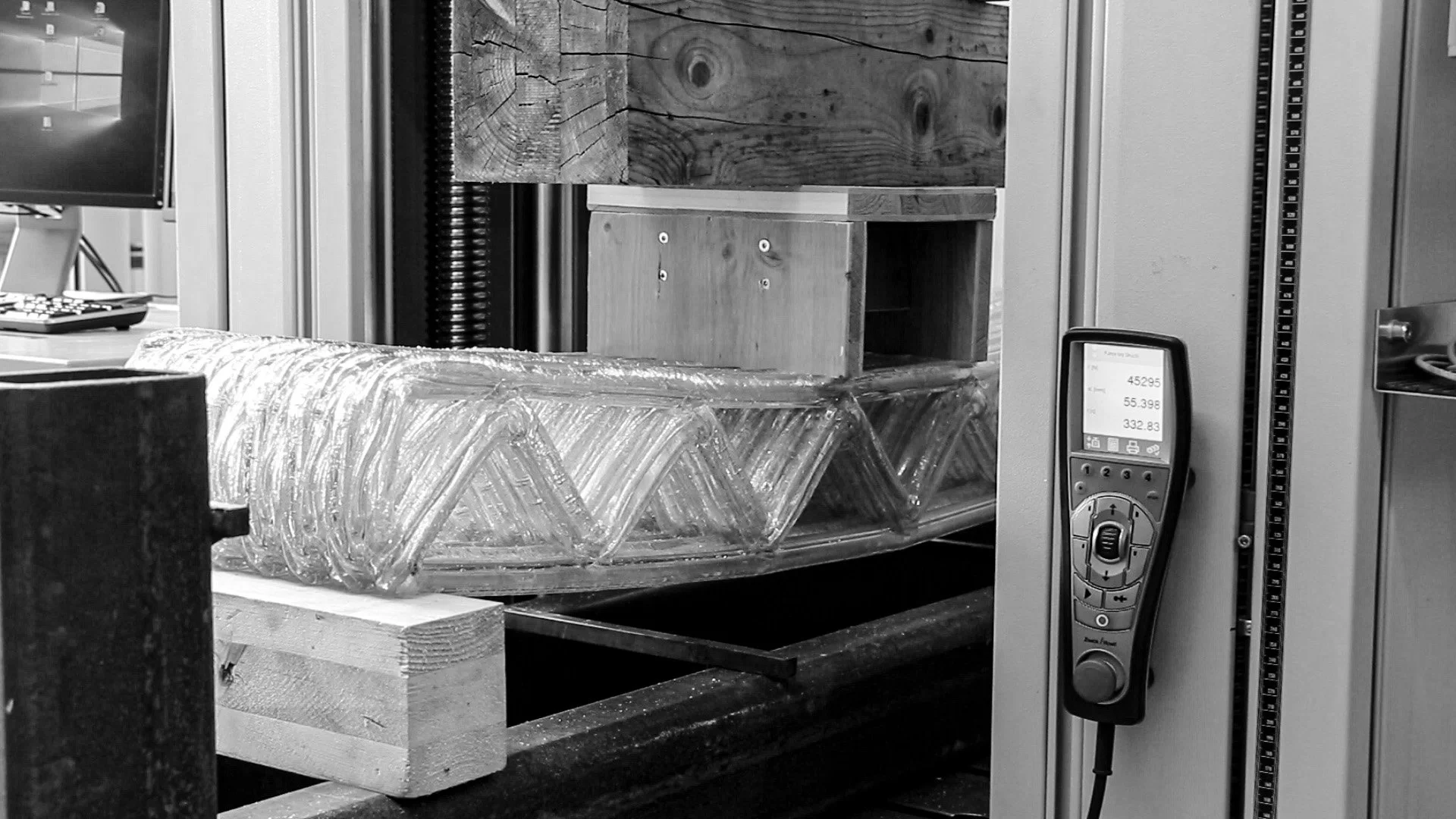
Leschok, Matthias, Thomas Wuest, Valeria Piccioni, Fabio Gramazio, Matthias Kohler, Arno Schlueter, and Benjamin Dillenburger. 2025. “Material Characterization and Structural Behaviour of HC3DP Elements for Lightweight Facades.”Developments in the Built Environment 23: 100703. doi.org/10.1016/j.dibe.2025.100703
Leschok, Matthias, and Benjamin Dillenburger. 2025. “Hollow-Core 3D Printed Formwork for Bespoke Concrete Structures.” In ACADIA 2025: Computing for Resilience. 45th Annual Conference of the Association for Computer Aided Design in Architecture. link to proceedings
Leschok, Matthias, and Benjamin Dillenburger. 2025. “From Patent to Production.” International Conference Architecture & Patents, June 18–20, 2025.
Leschok, Matthias, Marirena Kladeftira, Yen-Fen Chan, and Benjamin Dillenburger. 2024. “Large-Scale Hollow-Core 3D Printing: Variable Cross-Section and Printing Features for Lightweight Plastic Elements.” 3D Printing and Additive Manufacturing 11 (3): 907–918. Cover article. doi.org/10.1089/3dp.2023.0287
Leschok, Matthias*, Valeria Piccioni*, Gearoid Lydon, Bharath Seshadri, Arno Schlueter, Fabio Gramazio, Matthias Kohler, and Benjamin Dillenburger. 2024. “Thermal and Manufacturing Properties of Hollow-Core 3D-Printed Elements for Lightweight Facades.” Developments in the Built Environment 19: 100485. doi.org/10.1016/j.dibe.2024.100485
Leschok, Matthias*, Marirena Kladeftira*, Nik Eftekhar, and Benjamin Dillenburger. 2024. “Prōtóplasto: A Discrete Roof-Column System with Hollow-Core 3D Printing and Bespoke Space Frames.” In Fabricate 2024: Creating Resourceful Futures, edited by Phil Ayres, Mette Ramsgaard Thomsen, Bob Sheil, and Marilena Skavara. UCL Press. doi.org/10.2307/jj.11374766.19
Leschok, Matthias, Lex Reiter, and Benjamin Dillenburger. 2023. “Large-Scale Hollow-Core 3D Printing (HC3DP): A Polymer 3D Printing Technology for Large-Scale Ultralightweight Components.” Additive Manufacturing 78: 103874. doi.org/10.1016/j.addma.2023.103874
* equal contribution
TRANSFER
The process is in industrial production at SAEKI Robotics AG, an ETH Zurich spin-off.
PROCESS
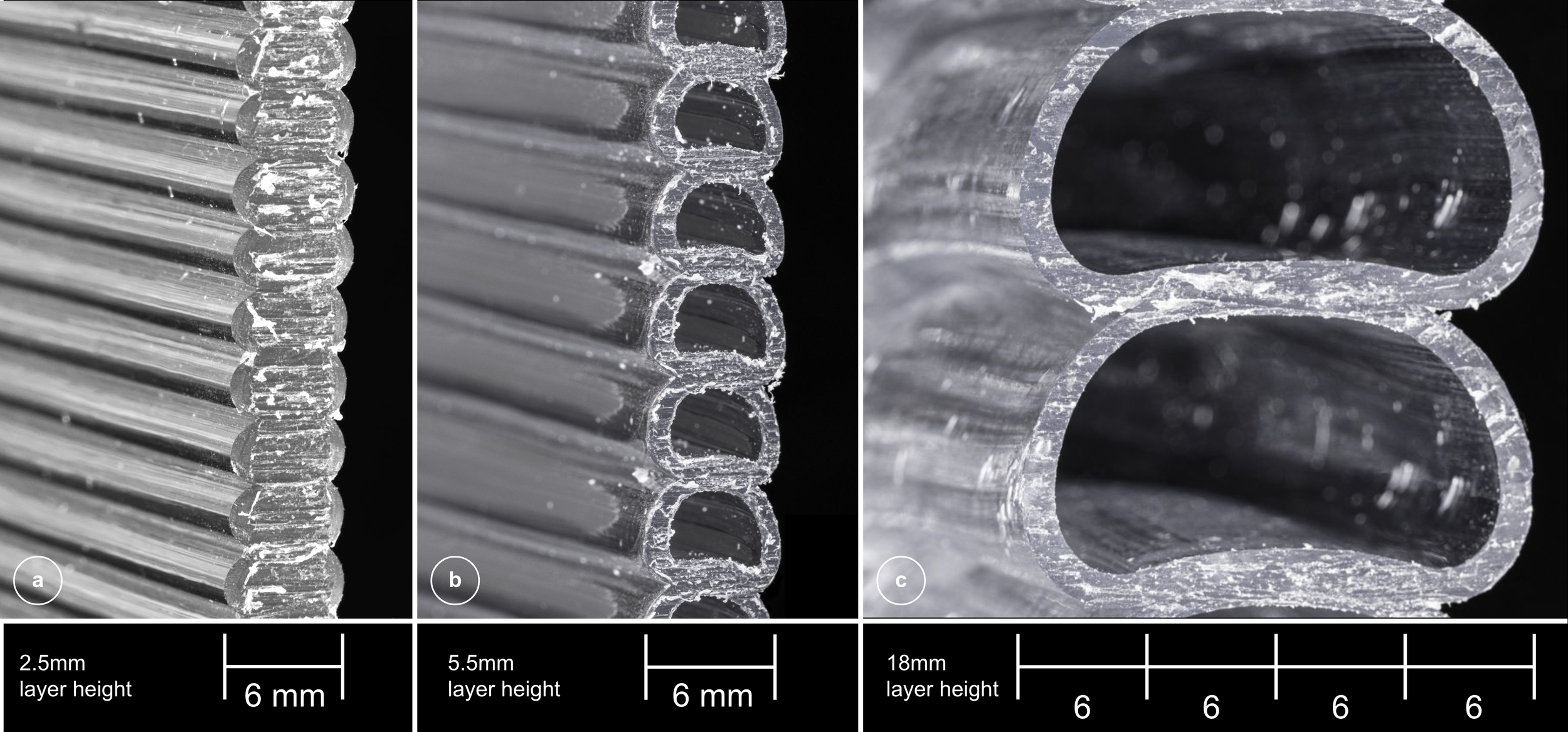
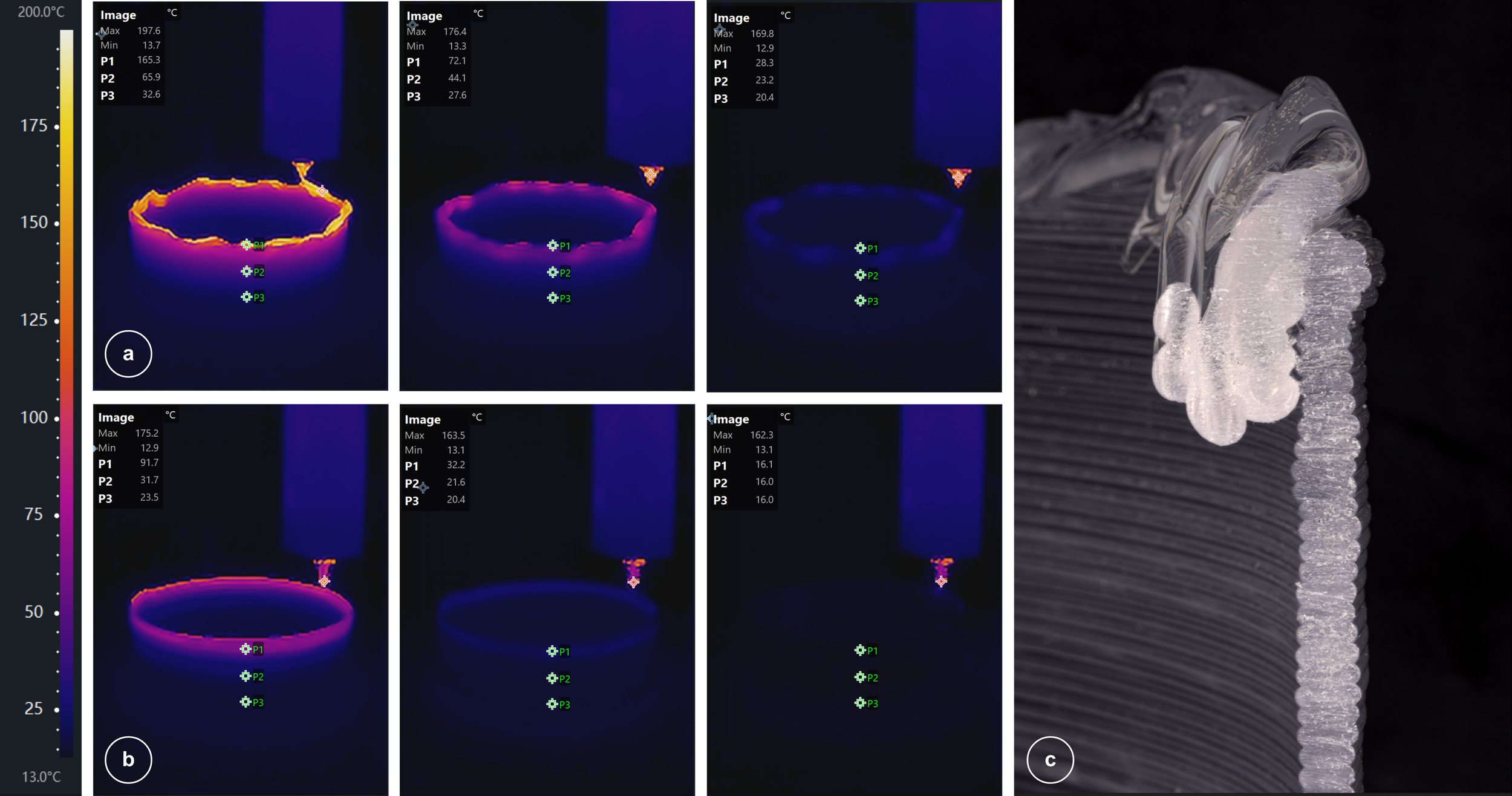
Cooldown is governed by wall thickness rather than by the size of the bead. A nozzle with a 24 mm orifice and a 1 mm wall deposits a cross-section of 362 mm² at 7249 mm³/s — against 615 mm³/s for regular material extrusion, a factor of almost twelve. Five minutes after printing, a conventional bead is still at 72 °C while a hollow-core bead has reached 32 °C.
Material savings against an equivalent solid cross-section reach 84%. Speed and material efficiency do not usually improve together in large-scale extrusion, since a higher rate means a larger bead and a larger bead means more material; the hollow section separates them. The gain has a limit at the other end: if the deposited material cools too far before the next layer arrives, layer adhesion can no longer be guaranteed and delamination becomes the risk.
A 2 m cylinder of 400 mm diameter is printed in 1 h 54 min at 10.3 kg. Print speed is capped at 20 mm/s, where overheating first appears — a limit set by cooldown, not by the extruder.
Large-scale hollow-core 3D printing (HC3DP): A polymer 3D printing technology for large-scale ultralightweight components · Additive Manufacturing 78 (2023) 103874
GEOMETRIC CONTROL
Internal air pressure is not only what keeps the bead open — it is what controls the diameter. Cross-section is varied between 16 and 32 mm within a single printed element, and from one wall to the next, without changing the nozzle. Layer height becomes a parameter set in software rather than a property of the hardware.
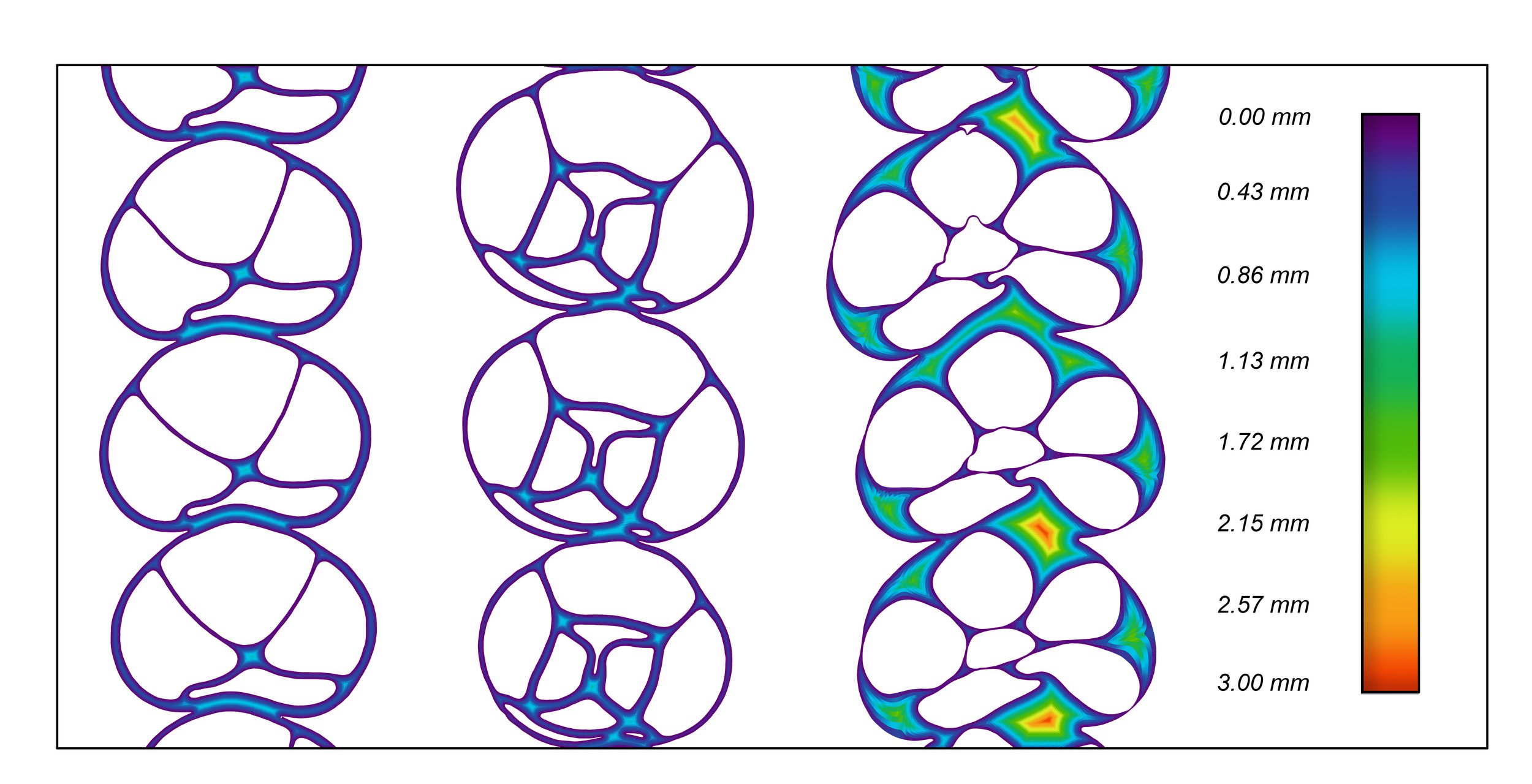
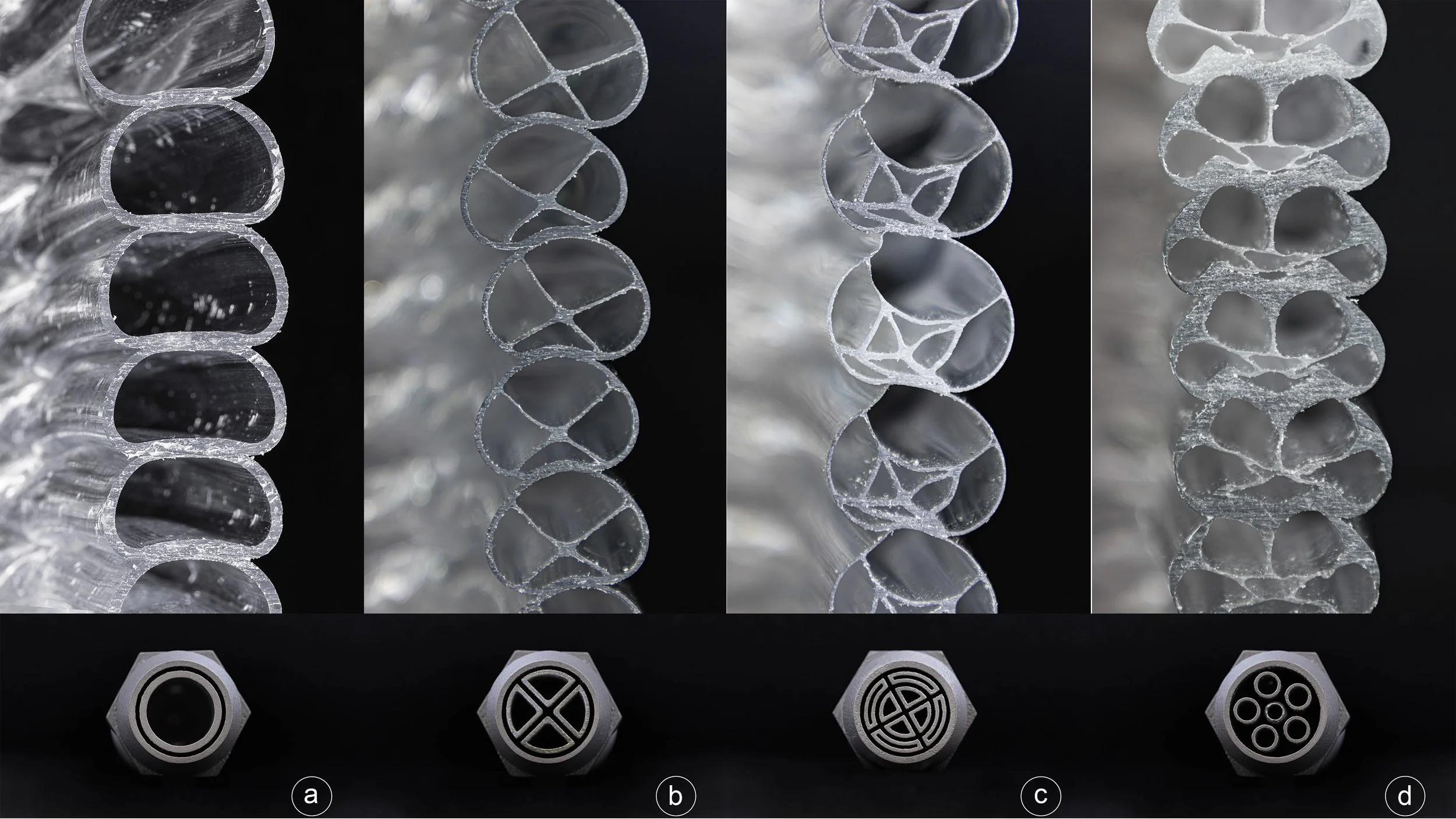
The same study introduces internally subdivided closed-section profiles: a reinforcing cross giving four pockets, a crosshair giving eight, a tube-in-tube arrangement of six. Printing them required a further concept — differentiated air pressure per print point. At this scale the bead section becomes a design space in its own right, and whether those sections can be held accurately by tuning print parameters or whether each pocket needs its own pressure control is the question the study leaves open.
Large-scale hollow-core 3D printing: Variable cross-section and printing features for lightweight plastic elements · 3D Printing and Additive Manufacturing 11(3) (2024) 907–918 — cover article
FORMWORK FOR CONCRETE
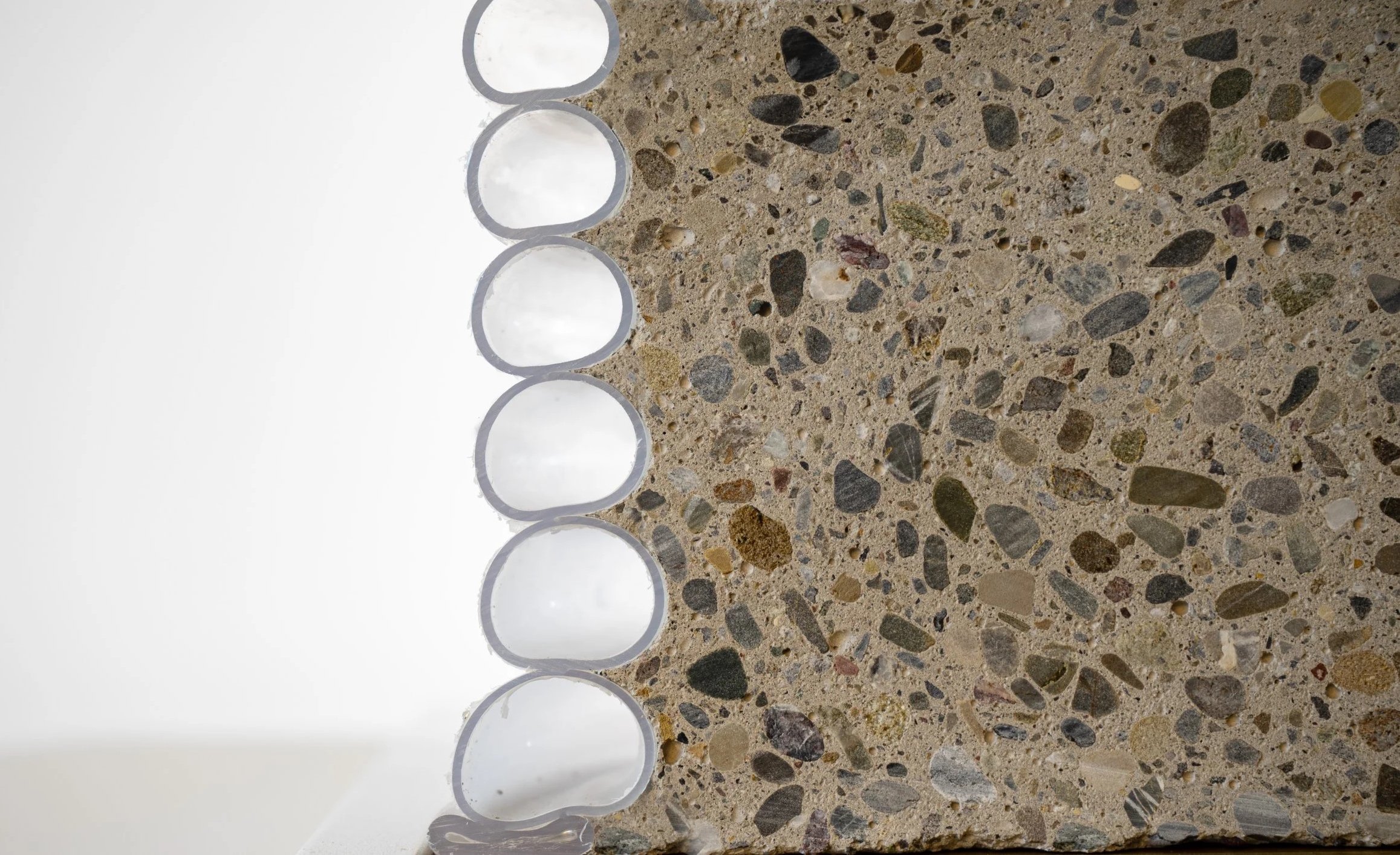
HC3DP is applied as concrete formwork for the first time. The closed section extrusion gives the formwork structural height against hydrostatic pressure while minimising material usage. A 2.1 m column formwork weighing 8.9 kg resists the pressure of standard concrete mixes without accelerated hydration, external counter-pressure or a sacrificial substructure.
Printed in under four hours, these formworks trade speed against resolution and minimal feature size. At approximately 18 mm the layer height is 10 to 20 times higher than other polymer 3DP formworks, which rules HC3DP out for sharp angles and fine detail and suits it to organic form. The cast concrete carries the imprint of the extrusion path as a wavy, undulating texture with sharp ridges — a resolution closer to 3D-printed concrete than to conventional casting.
Hollow-core 3D printed formwork for bespoke concrete structures · ACADIA 2025: Computing for Resilience
BUILT DEMONSTRATOR
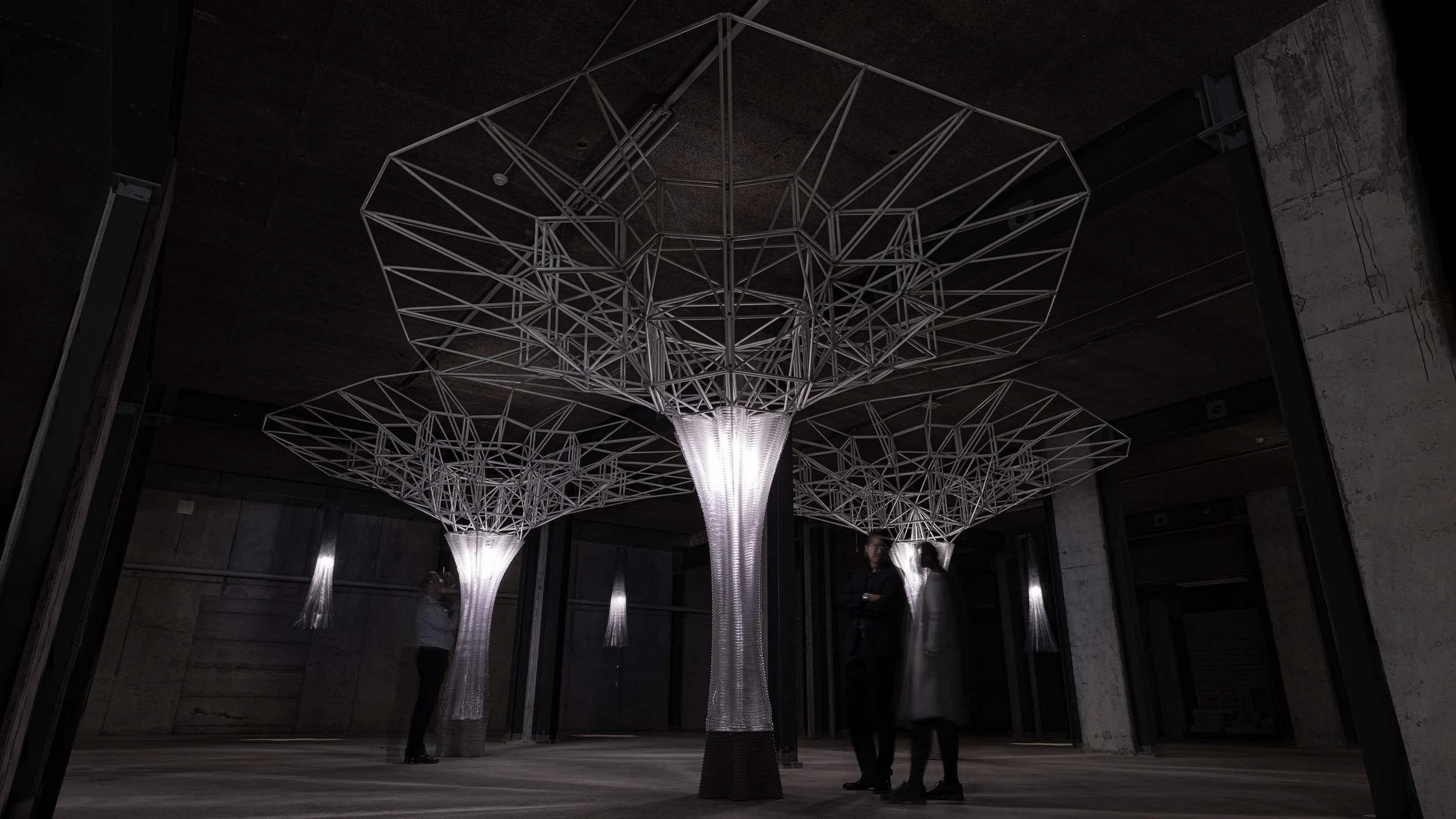
Prōtóplasto covers 65 m² at a weight of only 3.8 kg/m². Its three mushroom columns are printed at a bead diameter of 24 mm and a layer height of 19 mm, using the internally braced ‘X’ section rather than a plain ‘O’ to increase stiffness and load capacity.
The space frame is built from industrial 20 mm glassfibre rods, cut to bespoke length in a human–robot setup, the operator loading the feedstock and the robot positioning each tube for the cut. Roof modules average 3.7 kg, so two people assemble the ring radially without scaffolding.
Space frame and columns are post-tensioned together; the cable runs through the central joint of the intermediate roof module and traverses the column. The footings beneath are cast in HC3DP formwork, carrying the printed texture into the base.
Prōtóplasto: A discrete roof-column system with hollow-core 3D printing and bespoke space frames · Fabricate 2024: Creating Resourceful Futures, UCL Press