3D Printed Facades
The building envelope governs energy demand, emissions and occupant comfort, and is among the most complex components to fabricate: insulation, load transfer, solar control and weather protection are resolved within a single element. Large-scale 3D printing (3DP) allows each of these properties to be varied across one component, and printed facade elements have been demonstrated in polymer, concrete and ceramic. However, their performance is predominantly simulated rather than measured, and the relation between printing parameters and building-physical behaviour remains largely unquantified. This research closes that gap: Hollow-Core 3D Printing (HC3DP) is developed as a fabrication process for envelope components at architectural scale, and the thermal, thermo-optical and structural performance of the resulting elements is established experimentally.
PERIOD
2018-2024
CONTEXT
Doctoral research, Chair of Digital Building Technologies, ETH Zurich — carried out within Project 1C, Integrated 3D Printed Facade, NCCR Digital Fabrication (Swiss National Science Foundation, 51NF40-141853).
PROJECT STRUCTURE
A joint project of three ETH chairs — Architecture & Building Systems (Arno Schlüter), Gramazio Kohler Research (Fabio Gramazio, Matthias Kohler) and Digital Building Technologies (Benjamin Dillenburger) — with Lucerne University of Applied Sciences and Arts (Andreas Luible). NCCR Digital Fabrication spanned ETH Zurich, EPFL, Empa, HSLU, OST and USI.
COLLABORATORS
Valeria Piccioni, Bharath Seshadri, Gearoid Lydon, Ines Hischier, Arno Schlüter · Fabio Gramazio, Matthias Kohler · Ina Cheibas · Lars O. Grobe, Stephen Wasilewski (goniophotometry) · Benjamin Dillenburger (supervisor)
PUBLICATIONS
Leschok, Matthias, Thomas Wuest, Valeria Piccioni, Fabio Gramazio, Matthias Kohler, Arno Schlueter, and Benjamin Dillenburger. 2025. “Material Characterization and Structural Behaviour of HC3DP Elements for Lightweight Facades.” Developments in the Built Environment 23: 100703. doi.org/10.1016/j.dibe.2025.100703
Leschok, Matthias*, Valeria Piccioni*, Gearoid Lydon, Bharath Seshadri, Arno Schlueter, Fabio Gramazio, Matthias Kohler, and Benjamin Dillenburger. 2024. “Thermal and Manufacturing Properties of Hollow-Core 3D-Printed Elements for Lightweight Facades.” Developments in the Built Environment 19: 100485. doi.org/10.1016/j.dibe.2024.100485
Leschok, Matthias*, Ina Cheibas*, Valeria Piccioni*, Bharath Seshadri, Arno Schlüter, Fabio Gramazio, Matthias Kohler, and Benjamin Dillenburger. 2023. “3D Printing Facades: Design, Fabrication, and Assessment Methods.” Automation in Construction 152: 104918. doi.org/10.1016/j.autcon.2023.104918
Piccioni, Valeria, Matthias Leschok, Lars O. Grobe, Stephen Wasilewski, Bharath Seshadri, Illias Hischier, and Arno Schlüter. 2023. “Tuning the Solar Performance of Building Facades through Polymer 3D Printing: Toward Bespoke Thermo-Optical Properties.” Advanced Materials Technologies 8 (6): 2201200. doi.org/10.1002/admt.202201200
Piccioni, Valeria, Matthias Leschok, Gearoid Lydon, Ina Cheibas, Illias Hischier, Benjamin Dillenburger, Matthias Kohler, Fabio Gramazio, and Arno Schlueter. 2023. “Printing Thermal Performance: An Experimental Exploration of 3DP Polymers for Facade Applications.” IOP Conference Series: Earth and Environmental Science 1196 (1): 012063. doi.org/10.1088/1755-1315/1196/1/012063
Cheibas, Ina, Valeria Piccioni, Ena Lloret-Fritschi, Matthias Leschok, Arno Schlüter, Benjamin Dillenburger, Fabio Gramazio, and Matthias Kohler. 2023. “Light Distribution in 3D-Printed Thermoplastics.” 3D Printing and Additive Manufacturing. doi.org/10.1089/3dp.2023.0050
Seshadri, Bharath, Ina Cheibas, Matthias Leschok, Valeria Piccioni, Illias Hischier, and Arno Schlüter. 2021. “Parametric Design of an Additively Manufactured Building Facade for Bespoke Response to Solar Radiation.” Journal of Physics: Conference Series 2042 (1): 012180. doi.org/10.1088/1742-6596/2042/1/012180
Taseva, Yoana, Nik Eftekhar, Hyunchul Kwon, Matthias Leschok, and Benjamin Dillenburger. 2020. “Large-Scale 3D Printing for Functionally-Graded Facade.” In RE: Anthropocene, Proceedings of the 25th CAADRIA Conference, 183–92. Hong Kong. https://doi.org/10.52842/conf.caadria.2020.1.183
* equal contribution
OUTCOME
The fabrication process developed for this work → Hollow-Core 3D Printing
STATE OF THE ART
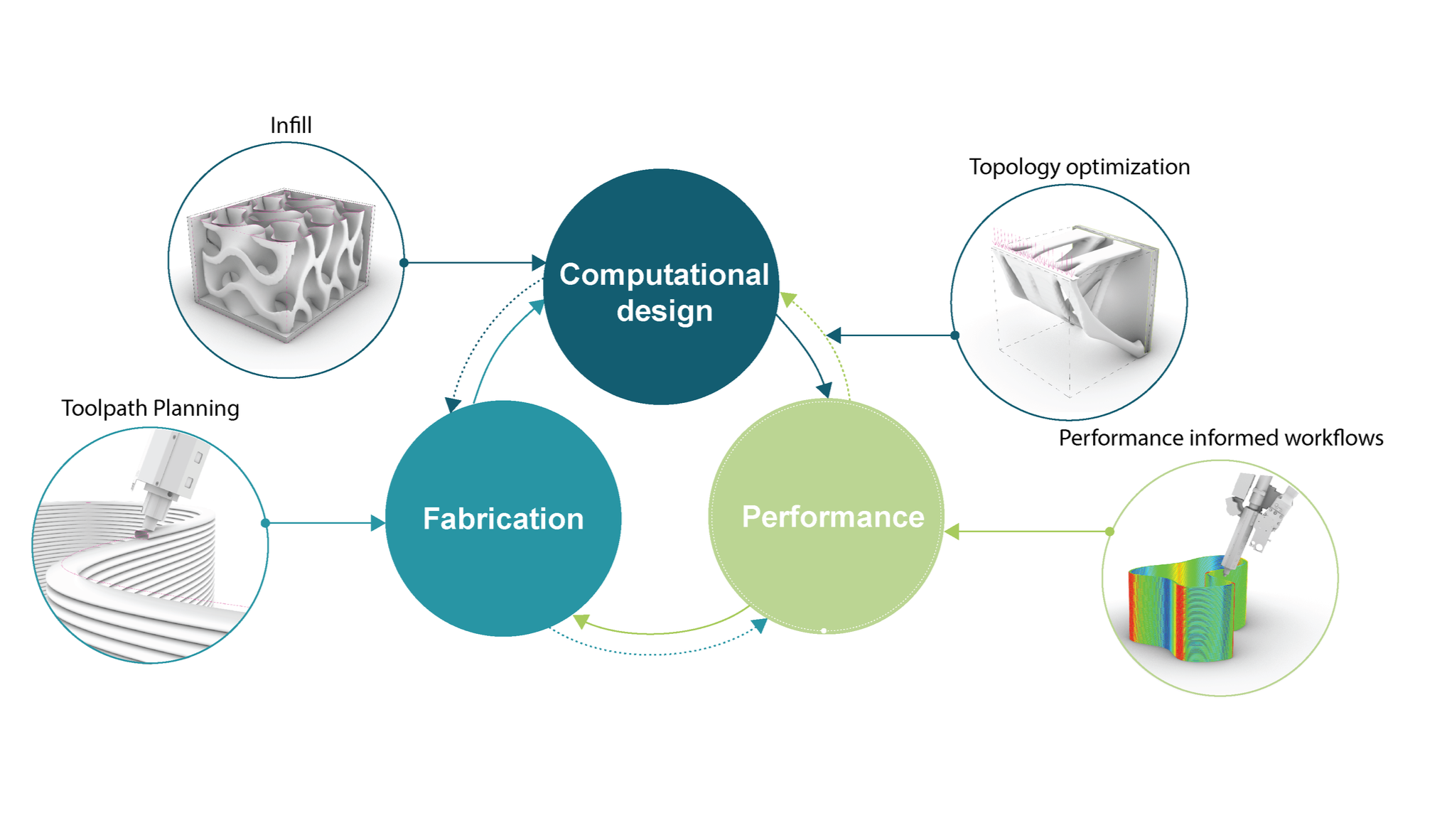
A state-of-the-art review covering approximately 180 studies structures the field into three domains: computational design strategies, fabrication processes and materials, and performance assessment. Sorted by material group, the review establishes which processes reach which application scale, and identifies the knowledge gaps addressed by the work that follows.
3D printing facades: Design, fabrication, and assessment methods · Automation in Construction 152 (2023)
THERMAL PERFORMANCE
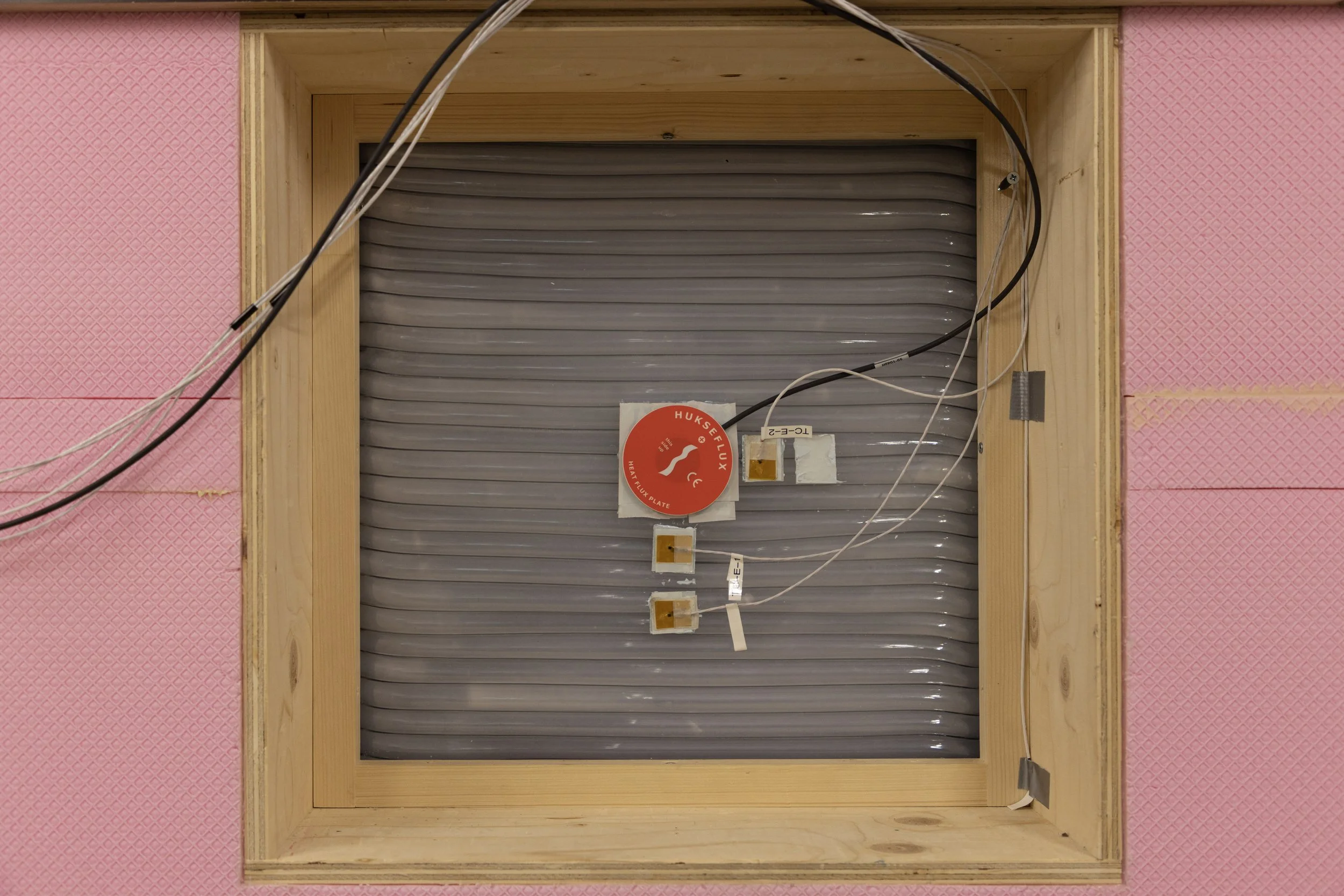
Thermal resistance is determined experimentally: twenty-seven desktop-printed specimens by dynamic conductivity measurement, and HC3DP specimens of 500 × 500 × 150 mm in a steady-state hot box. Effective thermal conductivity of the hollow-core specimens ranges from 0.30 to 0.15 W/mK with bead geometry and infill; filling the tubular bead with granular aerogel reduces it to 0.07 W/mK, less than half the best monomaterial value.
Two configurations fall below a thermal transmittance of 1.0 W/m²K: a monomaterial element of 150 mm thickness, and a 75 mm aerogel-filled element at 0.85 W/m²K, fabricated in just under 1.5 h/m2.
Thermal and manufacturing properties of hollow-core 3D-printed elements for lightweight facades · Developments in the Built Environment 19 (2024).
THERMO-OPTICAL PERFORMANCE
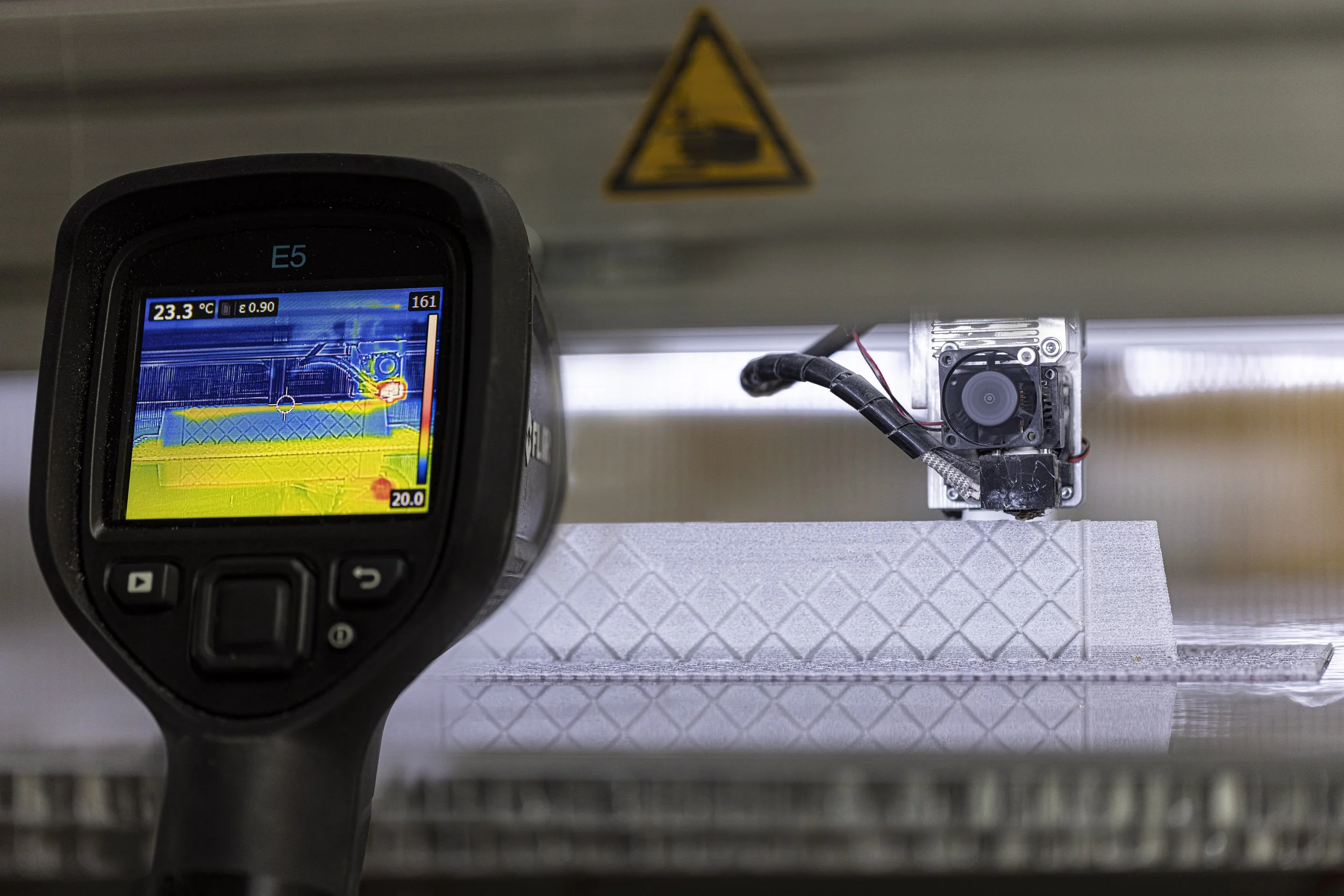
Twenty PETG specimens of 200 × 200 mm are printed with varying layer height and contour count and characterised on a goniophotometer, the measurements converted into data-driven bidirectional scattering distribution function (BSDF) datasets. Contour count governs specular transmission and haze; layer height governs angle-selective behaviour, with specimens printed at 0.1 mm exhibiting a steep drop in transmission at 70° incidence.
Solar control is therefore defined at the slicing stage rather than added as a separate shading layer.
Tuning the solar performance of building facades through polymer 3D printing · Advanced Materials Technologies 8(6) (2023).
STRUCTURAL PERFORMANCE
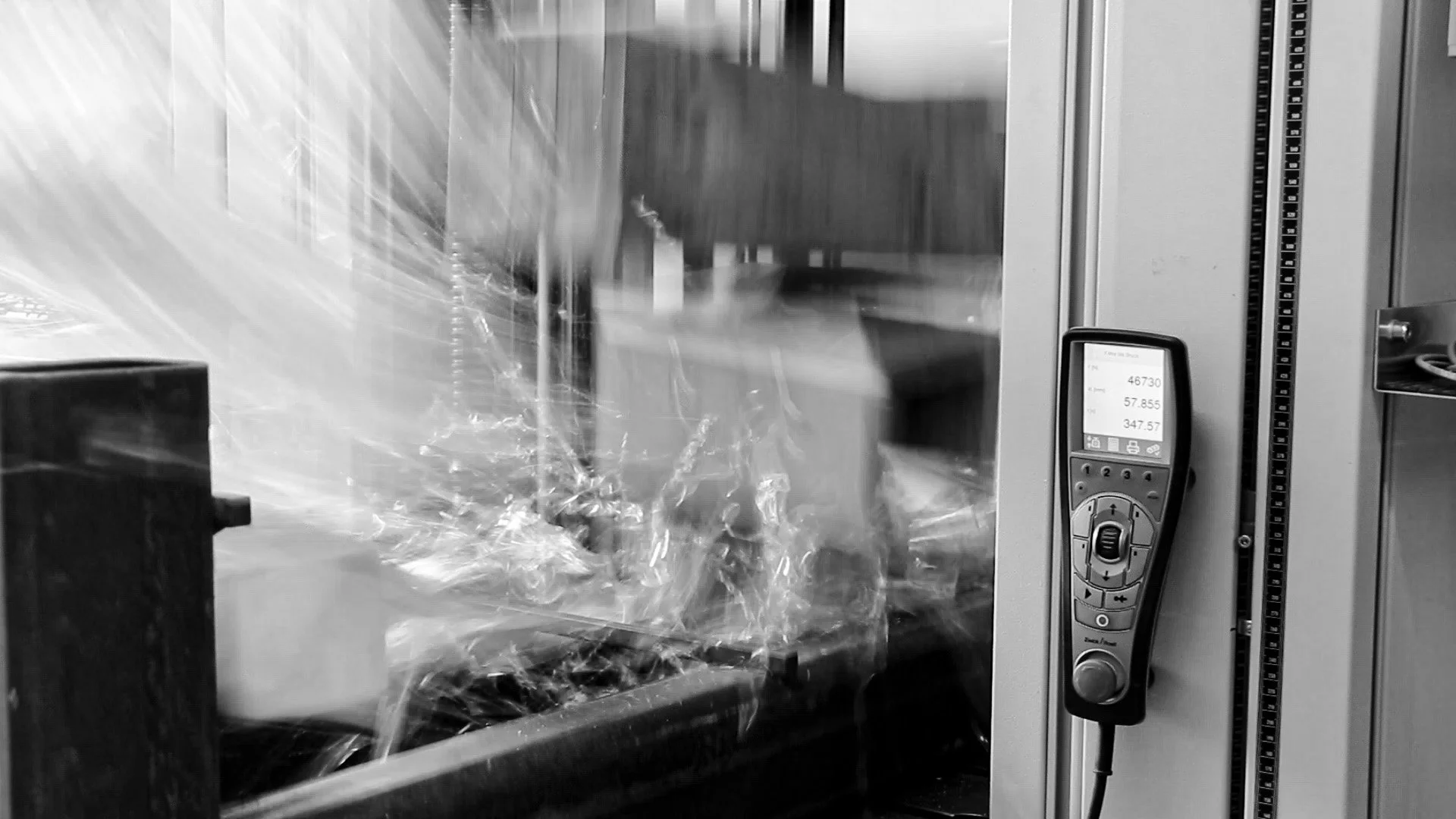
Printing direction, not temperature, governs the structural behaviour of HC3DP elements: tensile yield strength decreases by 55–62% between printing orientations, irrespective of whether specimens are conditioned to −15, 25 or 55 °C.
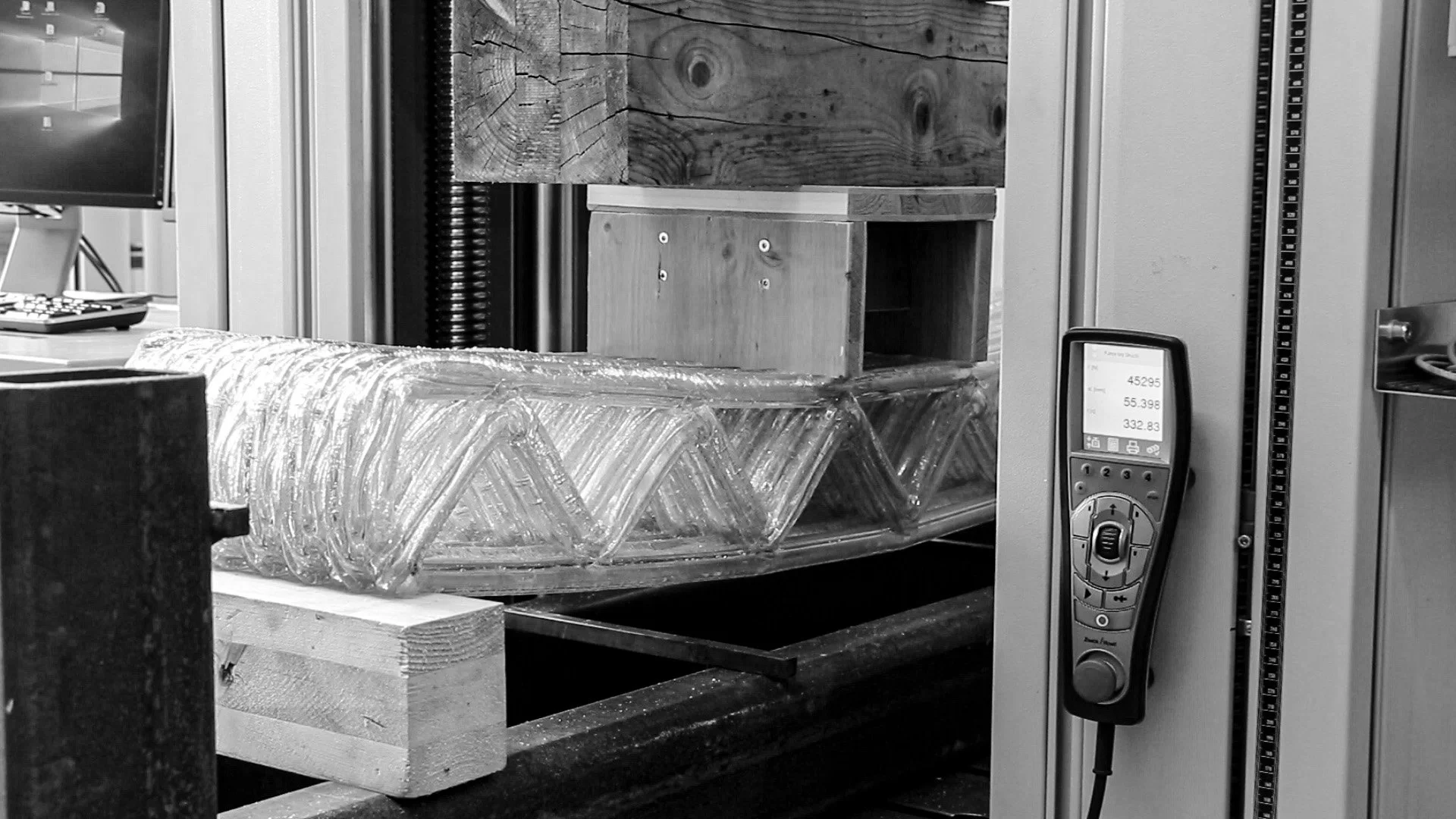
Offsetting shell and infill lines by half a layer height against each other using HC3DP raises the maximum load capacity to 45 800 N, corresponding to facade elements spanning up to 12 m. The gain requires neither new hardware nor material — it is a change to the slicing strategy alone.
Tensile specimens are tested in different printing orientations at each conditioned temperature; three-point bending is carried out according to ISO 178, and large-scale beams are tested in bending over a support spacing of 1200 mm.
Material characterization and structural behaviour of HC3DP elements for lightweight facades · Developments in the Built Environment 23 (2025)